The
Barn Theatre,
25 Bluehouse Lane, Oxted, Surrey
RH8 0AA.
Tel:
01959 561811
Email: barntheatre
@btinternet.com

Memories, Quotes and Snippets







From Julian
In her diary, Mary Spurgeon, who worked for the Red Cross and lived at Hill Garth, Bluehouse Lane, Limpsfield, talks of selling programmes, in uniform, for a performance of "Twelfth Night" at the theatre on 24th May 1936 in aid of the rebuilding fund for the Oxted and Limpsfield Hospital. After selling the programmes, she went on to the Oxted Cricket Fete.
From The Surrey Mirror in 1933
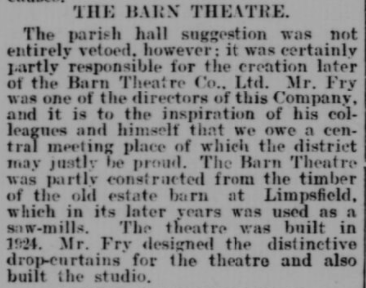
From Country Life 27th December 1924
This article about the early history of the theatre has recently come to light
From Sylvia Kattau (Mackenzie) (Found in Jill Perry's effects)
How to costume the opera 'Veronique' (Oxted Operatic Society) with 40 dresses for £37 in 1960.
From Don Pickett
My father George was the first of our family to appear on the Barn stage. He was a member of the Oxted band (he played the cornet), six of whom played street musicians in the Student Players production of Saloon Bar in 1949.
My sister Irene appeared in her first pantomime in 1953, one of the children from the Louise Browne School of Ballet. She performed in the pantomimes most years until she married in 1968.
My first show was in Yeoman of the Guard in 1954, I was 16. My partner as we paraded around the stage was Arthur French, a considerable age difference and also a considerable height difference.
My first pantomime, and speaking part was in 1955 as the town crier. As my proclamation was written on the scroll I didn’t bother to learn it. On the first night upon stepping forward to make my announcement I unrolled the scroll and discovered it was upside down. I hastily turned it up the right way, being panto I think I got away with it.
I appeared in numerous pantomimes with Frank Sowerby as the dame. He was the headmaster of the Old Oxted School where we would rehearse. Whatever the panto was it always included the famous sand dance performed by Frank, Jimmy Rogers and Stan Brown.
Nora Sowerby produced these pantomimes and what a talented lady she was. I will always be thankful to her for allowing me to play the part of Tevye in Fiddler on the Roof.
In the 1958 Student Players production of Spider’s Web I made my entrance through the French windows, was struck fatally on the head and collapsed behind the sofa. There I had to remain, partly visible to the audience for the rest of the play. I then had to remember which part of me could be seen for the following acts.
At the end of the final performance of Teahouse of the August Moon in 1961 Vic Silcox announced to the audience my engagement to Carole. She was watching on that occasion but participated in many pantomimes during the 1960s as a dancer and choreographer.
Me, Jimmy Rogers and Michael Butler wore suits of armour during the 1984 production of Princess Ida. When leaving the dressing room to climb the stairs to the stage Butler fell over with a tremendous clatter. Two stagehands managed to get him upright and we still entered on cue – what a trooper.
2008 Treasure Island and the ridiculous club foot I wore playing Long John Silver. I used to switch it from the right leg to the left for the second half – I wonder how many people noticed.
2017 my last show The Old Time Music Hall Spectacular where I performed “Ain't It Grand To Be Blooming Well Dead.”From Ralph Heijmer
Who remembers his late great aunt, Audrey Maxwell-Lefroy, who attended the Manor House School in the late 1920's / early 30's. The school stood next to Limpsfield Church, and is now is a private house adjacent to the Stanhopes estate which was formerly the school grounds. On the rare occasions she visited the Heijmers in Oxted, she vividly recalls and remembers the times with great fondness, where, as a special treat, the girls were permitted a visit to the Barn Theatre to "take in a show". Further excitement was added to the occasions where they were able to purchase "tuck" en-route (possibly from the old shop which stands on the junction of Bluehouse Lane and Limpsfield High Street) and take their hoards into the auditorium. She also the recalled the adventure of walking back from the theatre after nightfall in the dark with her friends sharing ghost stories!
From the Records
For many years the frontispiece to the Amateur Stage (magazine) consisted of pictures of the Barn Players Merrie England in 1950.
From the Records
In 1957 it was suggested that badminton and indoor cricket might be suitable activities to be held in the theatre.
From the Archives of All Saints Church
On July 6 1927 came the day Father Lang had been waiting for. All Saints Church, Oxted was consecrated and the papal flag was flown from it's roof to mark the occasion to passers by. The ceremonies began at 8.30 a.m. after an overnight vigil. Afterwards there was a lunch at the Barn Theatre for the Bishop, 19 priests and about 80 other guests.
From Patricia Bartrum (not quite a memory but if anyone knows anything about the event below, please contact the Theatre Manager)
My name is Patricia Bartrum and I was born in the Barn Theatre a long time ago on 16th September 1941. I no longer live in the UK, I've lived most of my life in the Netherlands. My father's name is A. Davies (Alec, Alex?) serving in the Princess Patricia Canadian Light infantry or the Sea Forth Highlanders Regiment. I don't want to contact him even if he is alive. I should just like to know if anyone remembers what happened and would be most grateful if they are able and willing to share information with me. My mother's name was Grace Bartrum. She died in 1983.
From Dizzy Moore
In the Autumn of 1938, the Croydon Repertory Company appeared at the theatre. It was sponsored by the Andreae family of Tandridge but unfortunately was not well supported.
In 1940 the Womens Junior Air Corps used the Little Barn and forecourt for drill.
In 1941 the theatre was used for a youth club organised by John Ferguson senior.
In 1942, ENSA used the theatre for concerts and Red Nicholls and Glenn Miller entertained the Canadian airmen stationed in the area.
From a programme produced by the Stranger Players on 9th February 19?
Season Ticket, 6s. 3d., entitles holder to a book of eight vouchers (transferable), each of which can be exchanged for one ticket at half-price for any performance. By 15th December a season ticket cost 12s. 6d., and held sixteen vouchers.
From Martin Lloyd (who worked with theatre Director Brian Styles (his future father-in-law) on many Student Players shows
In 1974, the lighting box was unheated and during panto's we welcomed the darker scenes in order to generate heat from some of the Strand resistance dimmers and the huge master dimmer through which one could switch the circuits if needed. There was no insulation and the roof felt and tiles was all there was between you and the elements.
On the ledge in front of the window, would be an old tobacco tin into which Brian would tap out his pipe.
I remember one performance during a panto, Brian would be smoking his pipe and also would often have a nip of whisky to keep the cold at bay. As usual, he placed the glass on top of the grille which surrounded the master dimmer. The dimmer was set about half (50%) so heat was rising nicely from the resistor elements when Brian knocked his glass of whisky over sending the contents cascading down over the hot elements. Vapourised whisky rose from the dimmer leaving us both waving our arms madly to disperse the concentrated flammable cloud.
The view of the stage from the lighting box was through two small glazed windows cut through the lathe & plaster wall at the rear of the gallery. The lighting operator and assistant would almost touch heads if both wanted to look at the same time.
There were 36 circuits (channels) each with a Strand dimmer. Each dimmer measured roughly 3' tall and they were set in three rows in front of the operator. Each dimmer was contolled by a 3-way switch, the position of which decided whether it was independent of the Master, linked to the Master or isolated.
Communication to the stage manager & orchestra was by cue lights and an ex MOD field telephone on which you had to wind the handle to ring the bell at the receiving end.
All spare lighting equipment was carried from the lighting box to the stage and back. This was laborious and lamps blew more frequently as a consequence.
There was only one FOH lighting bar. As I remember the first 'sophisticated' lighting equipment was the colour wheels on the FOH bar which required additional controls.
From an Introduction to Edward the Second by Christopher Marlowe
In Oxted, England, the Holywell Players, directed by Kenneth Johnstone, performed Edward II with an anonymous cast at the Barn Theatre on 2 April 1928.
From Terry Rolph
Terry Rolph remembers going in 1970 to the Plaza Cinema in Oxted with Lionel Pearson, Jack Wettern and a lorry to collect the seats for the theatre. They cost 3/- (15p) each.
In a programme produced by the Acstede Players in the 1920's
Adverts for The Surrey Mirror, whose local office was in Lloyds Bank Chambers; John Ferguson, Radio and Electrical Engineer; G.H. Lunn, High-Class Confectioner and Tobacconist; W.Suter, Photographer whose phone number was Oxted 167; R. Collyer Hamlin, Auctioneers, Valuers, House, Land and Estate Agents; Sevenoaks Chronicle where it cost 1½d per word to place an advertisement, minimum 12 words; F.H. Skinner with milk straight from Park Farm, Limpsfield; G. Bateman from Titsey Corner, Limpsfield with finest quality grocery and provisions.
In a programme produced by the Oxted and Limpsfield Players in 1930
The Oxted and Limpsfield Players have never aimed at being a profit making Society, but on this occasion the performance of "Twelfth Night" is being given to raise money. We now wish to build our own rehearsal rooms, store rooms and workshops and to have a central place where our members can meet. Almost £700 has been raised and we can now make a start. A plan which involves and has the wholehearted co-operation of the Barn Theatre Co. Ltd. is to be expounded at the Annual General Meeting of the Society, to be held on Thursday, July 10th 1930, at 8.30pm at the Barn Theatre. Any non-member interested in this plan will be heartily welcome at this meeting and donations will be most gratefully received by the Hon. Treasurer, Mr. H.G. Whitmore, Pilgrims Hatch, Oxted. The whole building which can be erected in sections will require approximately £1,700.
From Rita Townsend
I can remember coming with my father to see a show put on by the Canadian Seaforth Highlanders for three nights in 1943. There was a total smoking ban in force and my father handed over his matches and cigarettes at the door before we went into the theatre. The theatre was packed and there were soldiers sitting and lying along the beams. I remember it as being a funny variety show with soldiers in drag, which as an 11 year old I didn't understand.
In about 1950 I appeared in a pageant called (I think) Through the Ages - Family Album. I wore a circa 1860 wedding dress which belonged to a dentist who lived in Detillens Lane.
In a programme produced by Community Theatres (Croydon) Ltd. in 1939. [A repertory company who produced a series of plays at the Barn]
Congestion in the car park on Saturday nights has been rather heavy and so we have engaged an Attendant and your kind co-operation with him will, we are sure, enable you to leave your car in a safe position and, when the show is over to get away with the minimum of delay.
I have a sneaking fear that as television finds its way into the homes of playgoers, their loyalty to the old love will be very severly tested. [Attributed to the programme editor who had borrowed a television during a bout of flu].
From Alan Dell who was evacuated to Oxted during the war
I was evacuated to Oxted in September 1939, with other boys from Haberdashers Aske School. I arrived about 2 weeks after everyone else and was billeted in Monkchester, Blue House Lane, Limpsfield with two other Askeans. We were with an elderly lady, two servants and a pekinese at the far end of the house. The main part of the house was occupied by a Colonel Lawrence and his wife, who had a young servant who fed us in the kitchen, largely on baked apples! We slept on matresses on the floor of the 'Ballroom'. On Sunday evenings we had to be ready at 7pm to be admitted to the Drawing Room to sing and play Monopoly and card games.
Just before Christmas we asked to be billeted elsewhere and were moved to a house called Pollards Oak in Red Lane. To get to school at the Barn Theatre meant a walk across a field with a herd of heifers and inevitable cow pats to catch the steam train for the short journey to Oxted. There were Nestle chocolate and nuts and raisins machines on the platform at Oxted. Then we had another short walk to the Barn Theatre, which Askes occupied in the mornings. One day there had been a heavy snowfall and having walked all the way to 'school' we were sent home again immediately. The teacher used to stand on the stage in the gloom.
We dug the ground between the theatre and the school in lines to create an allotment. I was a member of the School Cadet Corps and we paraded in the theatre grounds. The officer in charge at the time was Major F R Wright (known as Fritz) who lived at Midway opposite Granville Road.
From Jill Perry
'The final night of the very first Operatic Society production 'The Yeoman of the Guard', the Andreas of Tandridge Court brought their party to the production in full evening dress - wonderful'
'At another performance, the whole lighting system fused and Frank Sowerby made a plea from the stage (in the middle of the show) "Is there an electrician in the house"!
'For the production of 'Veronique', we borrowed a donkey from the farm at Staffhurst Wood. A ramp was built from the men's dressing room to the stage for the donkey to ascend (even he/she/it couldn't climb the stairs!) and of course, no oats before the performance!
From my Kitchen Window (Matte Breminer at 74, Bluehouse Lane, Oxted)
When I grow up I want to be a builder. A roofer to be exact. What a life!
I could bask in the sun, top up my tan. Every now and again I could scale a ladder to get a better view of things - and maybe a better reception for my mobile phone?
I could spend days talking to all my many friends - who, presumably would also have to be roofers.
I could listen to music, chat to my mates. Shift a few tiles when the urge came over me, which would not be very often. If it rained, I could sit on a pile of tiles under a cosy canopy, drinking tea and putting the world to rights with my colleagues. I could eat lunch any time, which would obviously be quite often. I could play football with an empty drinks can if the fancy took me or have a little read of a magazine. What a life that would be.
A bit like being a housewife really, but without the chores.I see all sorts. Year sevens, eights, nines, tens etc. Sixth formers, teachers secretaries, technicians. You name them, I've seen 'em.
They have three things in common as far as I can tell:
1. They all have a fag in their mouth
2. They are all hiding from the school (or should that be 'skiving'?)
3. They all hang out on the Theatre steps
I study them with moderate interest. It passes the time while I do the dishes. I examine body language, I laugh at their sillyness and pranks. I feel for their consciences, I hope for them they go undetected - especially that biology technician, he always looks so sad and lonely.
And then, then ... I can hardly contain my indignation; YOU go and cover the steps. You build an extension. MY steps are now indoors. I can't see them any more. They are simply no longer there. Where shall I now get my distraction, my daily dose of voyeurism? Have you no respect? Have you no consideration?
Oh, how could you?They are so cute, those young men. They are really only boys. They turn up in their cars. It is usually around three in the afternoon in the Theatre car park.
I think they are there to impress the girls. They have the music blaring (at least it is only for a short while). They show off, they joke and prance around. Just being young men, really.
I can always tell when a boy has just got his first car. Usually it doesn't look particularly roadworthy, but his pride and joy is obvious.
The others gather round. They look under the bonnet, they listen to the engine. They try the driver's seat, they sit in the back, they check the boot.
And then they always do something which, in all these years (more than 15), I have never understood; they kick the tyres. They walk around the car, kicking the tyres one by one. Why? are they checking the tyre pressure? are they looking for loose nuts? are they seeing if the car will collapse? are they trying the toe of their new boots? are they showing off to their mates?
Someone tell me please?One day the doorbell rang. It was that nice guy with the beard from the theatre, asking if I had a small 'ladies mirror' he could borrow. The problem was the plumbing. He couldn't see behind the basin if the pipes were okay and thought a small mirror would do the trick.
I knew I had one. A mirror, that is. I looked for it. In my hand bags, in the bathroom cabinet and many other places. But no mirror. After a while the nice guy with the beard said he had better return to work. He could use a piece of card with silver foil on it, maybe.
I gave him a piece of kitchen foil.
Two days later I finally found my mirror. By then the plumbing was fixed - I presume - there was nobody at the Theatre. I now keep my little mirror handy at all times, just in case.Between the Theatre drive and the house next door, there is just one single raised kerb stone. It is, I suppose, a fairly standard two or maybe three foot long.
On either side of it the kerb slants downwards to meet the raised level of the two driveways. It is amazing the size of car you can park in the max 3ft space.
I have seen Rovers, Volvos, huge estate cars and even vans parked there. I also see the chaos it causes to the general traffic situation in and out of the Theatre and the inconvenience to my friends in no. 23.
Do these parkers think their cars become invisible? Do they, like Cinderella's ugly sisters, imagine they can fit the slipper just by squeezing hard enough? Or do they not think at all? Are they blind? The questions are many, none of them particularly flattering, though.
Me? Oh, I don't care, it is all grand entertainment from where I stand.From Des Groves
Cleaning out the mud and dirt from under the stage. This needed to be done every so often as it was prone to flooding.
The opening night in 1947 of the 'Yeoman of the Guard', an audience of 300 (there were more seats than now) and the magnificent set of the Tower of London.
The failure of the lights in 'Yeoman of the Guard' and the request for an electrician. Fortunately there were only three people on stage at the time and luckily there was an electrician -Heath Robinson, Head of the Electric Board -in the house who was able to sort things out.
Having a full sized Jeep on stage for 'Teahouse of the August Moon'. A ramp was built and it was brought up through the double doors that were then in the centre of the stage at the back.
Performing 'Merrie England' wearing heavy Elizabethan costumes on a very hot Monday evening in May with the top lights and footlights on. We thought we were going to expire but luckily the week cooled down.
Power cuts during one show when we requested the audience to shine torches on stage. Unfortunately, when it was a proper blackout, on came the torches.
Clearing the car park of snow to let the pantomime cast and audience in.
The noisy toilets in the dressing rooms which reverberated round the Theatre. You were not allowed to flush them during the show unless it was a very noisy bit.
I first appeared at the Barn in October 1938 in a Cubs and Scouts "Gang Show" where the Cubs did a sword dance and the Scouts performed a piece from "Snow White and the Seven Dwarfs". Don Jeal performed with the Scouts.
From the Records
When the land for the theatre was purchased from Mr Charles Hoskins Master (Lord of the Manor of Oxted) in 1923, the design had to be submitted to a special committee for approval. Hoskins Master himself was a member of this committee and whilst permission for the building was granted, they refused to allow alcohol to be sold at the theatre. This was to safeguard the sales in the nearby Hoskins Arms. This situation continued until 1980 when permission was finally granted and the bar was built.
A letter from Flora Robson who appeared with the rep. company the July Players in 1924
I was working at the Repertory Theatre in Oxford and this was a summer vacation where I was pleased to be asked to act for this group of friends from Oxford. Tyrone Guthrie was also at the Oxford Rep. at that time ... I was in a one act play in verse written by Christopher Scaife... The play was a sort of morality play called 'The Triumph of Death'. A poet (Christopher Scaife) longed for love and a woman who had a suicides death for love (that was me). I longed to return to where I had come from and was unfaithful so that he could hate me and I could go back. Death was played by Tyrone Guthrie. The Inn Keeper, my other lover was Robert Speaight and another was Cecil Bellamy. All the others in the cast were Oxford undergraduates.
We had all our expenses paid and were housed by kind hosts. We shared any profits and made about £3.00 each. It was a glorious summer, we ate in inns and bargained for our food, which was delicious and cheap. Shops round lent us furniture and carpets at ridiculously low prices, that was how we made it a holiday with work and play.
We were not really a professional company but it gave Mr Amner Hall the idea of starting play productions. So something very big came out of it.
I had one startling incident there. When the poet turned on me and said he hated me, "as loathsome as a corpse from a grave", I turned and hid my head in a curtain. A death's head mask was then fitted to my face, so that when I fell into the Inn Keeper's arms, I was a skeleton! (Green light). We made the mask ourselves. We had the 'Girl Drowned in the Seine' piece of sculpture and made a papier mache mask on that. The dress rehearsal was long and I wanted to watch the end of the play, so I did not lie there dead, I got up and watched from the front. So that on the first performance, I fell and then found, very soon, I had made no nose holes to breathe through! The mask fitted tight around my chin and I could hardly breathe and was soon heaving. I did not want to spoil the effect that I was dead. Luckily, before the magic entrance of Death, the lights dimmed very low and I, lying in the shadows, very slowly moved my hand and pushed the mask up so that I could breathe again. Just think, I might really have been a corpse when the curtain call came!
From Marjorie Mack in the book Hannaboys Farm (now Gincox Farm) on the occasion of a demonstration of Country and Morris dancing (in 1924) in which Christopher Fry performed
The old oak beams and plain whitewashed walls of the theatre, which was indeed a barn that had been moved piecemeal from its original site, made the nicest kind of background to the old dance and the old tune. The lighting too - sunlight and green grass seemed almost to be conjured up; but then the lighting of the Barn Theatre had been designed by one who was also an artist.
Christopher (Scaife) was so impressed with the lighting in the theatre he arranged with Muriel Whitmore to hire it for three days towards the end of July 1924. He and his friends from Oxford University Dramatic Society wished to perform a dramatic poem he had written called Triumph of Death. The cast were accommodated in the cottages of some friendly folk in the area. As the play progressed it reached the part where Death had brought the Woman (played by Flora Robson - see letter above) back from her grave. She stood close to the folds of the curtain and turned aside her face, pale with doom but turned to face the audience again seconds later as a leering skeleton. There was a shriek from the back of the house; up in the gallery which was filled with pupils from the girls boarding school, someone had fainted. Throughout the theatre there was sensed a silent but violent, almost a hysterical commotion. Nobody was breathing in the ordinary way. A few moments later we were all pouring out of the theatre, trying to laugh it off, trying to account for it. What sort of acting was it we had just seen, that had unnerved us, moved us all so unexplainably? Who were they, these July Players? Besides Christopher himself, they were Tyrone Guthrie, Molly McArthur, Robert Speaight and Flora Robson.
From Michael Tippett in his autobiography "Those 20th Century Blues"
On 5th April 1930, I organised the first ever concert of my own works at the theatre. The performers were a mixture of Oxted Singers and some professional soloists and an orchestra with David Moule-Evans as conducter. I designed the programme myself, but absent mindedly omitted my own name as composer.
The main problem was that there was no orchestra pit. But by opening up the front of the stage it was possible for the orchestra to play underneath it, with myself sitting on the floor to conduct. Unfortunately, the players were then slightly under water and had to come in wellingtons! More seriously, the singers found it difficult to hear the orchestra, so we had to drill 'hear-holes' through the stage floor and every so often the singers went to them and cupped their ears to listen.
© Michael Tippett. Those 20th Century Blues. 1992
From The Times on April 7th 1930
'Concert in Oxted Barn Theatre'
"Five works by a local composer, two of them settings of words by local poets, were last night performed with some outside assistance by the local players and singers here in the Barn Theatre, which has already acquired a more than parochial reputation for native artistic effort. The composer is Mr. Michael Tippett, who conducts the Oxted and Limpsfield Choral and Orchestral Society; last night however, he handed over the direction of the larger works in the programme to his friend and neighbour Mr. David Evans".From the Morning Post on April 7th 1930 in the review of weekend concerts
"The concert of works by Michael Tippett, given on Saturday by the Oxted and Limpsfield Players in the Barn Theatre at Oxted, afforded one of those glimpses into the hidden musical activities of this country that gives hope for the future and are so stirring. Of course, this sort of thing - compositions by a young composer, performed by friends - is often to be discovered, though not all young musicians have the remarkable gift of Michael Tippett. The programme was made up of a concerto for flutes, oboe, horns, strings, three songs, pianoforte variations, a string quartet and a psalm for chorus and orchestra. Mr. David Evans conducted effectively and with understanding. All the performers were attentive and willing, models of what helpers in the finest causes should be".
From the Records
During the war the dressing rooms became kitchens and the auditorium sleeping quarters for over 100 Canadian soldiers from the First Canadian Division. After the soldiers left, the theatre was taken over by the Education Authority and the Aske School was evacuated from London. It was subsequently used for lessons and meals and the pupils followed the example the soldiers had set by leaving their names scribbled on the inside of the box office, dated 1941.
From Gillian Antrobus (nee Sowerby) who visited the theatre as a child with a group determined to restore the theatre to its pre-war condition.
"I went with them on this expedition of exploration and can remember how dark and musty it was. The place was covered with dust and cobwebs, the war period had caused devastation in the Barn Theatre. The stage was covered with old trestle tables from the canteen, only a few theatre seats were available. The interior was delapidated, dressing rooms and lavatories were filthy and the heating system was rusted and out of action. In no way did the building conform to the requirements of Surrey County Council for a licence for public usage."
From the Records
The first production after the war was to be 'Yeoman of the Guard' by the Oxted Singers. At the last minute, the Council refused to grant a licence for the theatre on the grounds of some small technicalities regarding the refurbishment. As the production had been advertised everyone was reluctant to change the venue and someone hit upon the idea of a 'board of friends'. The Oxted Singers became the Oxted Operatic Society and for a joining fee of 5/- (25p), members were entitled to see the production free. With this idea, no licence for public usage was necessary.
From Nora Sowerby
In the early years there was no scenery, but Dr Andreae produced some naval sailcloth. Frames were made and flats were subsequently produced but as the cloth was still covered in oil they proved very difficult to paint
From the Records
The Barn Players were formed in 1948 and later that same year they featured in the national magazine 'Today' (No 19) under the heading of 'Amateur Actors'.
From the Records
In the 1950's footlights were installed in the theatre. They replaced the old method of a candle in a biscuit tin. In 1956 the lighting switchboard which had been controlled from a box at the side at the stage was moved to the rear of the gallery which allowed the operator to see the stage.
From the Records
In the early days, although the theatre was designed to seat 300 people, the seats were pushed together to accommodate 350. Now it seats 248.
From the Records
In 1926 the yearly membership fee for an acting member of the Crichton Dramatic Club was 10/- (50p) and a non acting member 5/- (25p).
From the Records
Some of the timbers in the theatre came from oak trees growing at the time of the Norman Conquest.
From Mrs Muriel Whitmore who started the Oxted and Limpsfield Players prior to the Barn being built
When the theatre was built, this society had a membership of nearly 300 with a minimum subscription of 2/6 (12.5p).
From Gill Antrobus
When dances were held in the theatre, all the seats were moved to the sides leaving a clearing in the middle and the band played on stage.
From the Records
The first two productions presented in the theatre, only a week after it opened in May 1924 were 'School for Scandal' and 'As You Like It'.
From A.G.G. in 'The Nation' on May 31st 1924
"I had the pleasure of witnessing one of the performances given this week to celebrate the opening of the Barn Theatre at Oxted. The plays presented were 'School for Scandal' and 'As You Like It'. Both were given by the villages of Oxted and Limpsfield and the rending of Sheridan's comedy which I saw was admirable ....... costumes and scenery alike were of local production and the whole affair was a remarkable tribute to the village drama movement which the British Drama League is encouraging."
From the Records
The Crichton Players who were one of the first companies to use the theatre were named after their first production.
From the Records
In 1948 a repertory company hired the theatre. They had nine permanent players and also used local people and actors from London with Harold Norway as the producer. They played weekly for a while but audience numbers were small and they eventually left Oxted greatly in debt to local shop-keepers and tradesmen and to the Barn Theatre. The man in charge of the financial side of this repertory company subsequently spent some time in prison as a result.
From the Records
In the past the theatre has been used for auctions, eisteddfods, drama festivals, musicals, operas, operettas, concerts, horticultural society shows, plays, pantomimes, art exhibitions, dances, literary debates, barn dances, parties, wedding receptions, dancing school and Country and Morris dancing shows, canteen, school room, barracks, evacuation dispersal point and a nursery school in the Little Barn.
From the Records
Benjamin Britten played at the Barn on Wednesday 25th March 1957 together with Peter Pears in an Oxted and Limpsfield Music Society Concert.
From the Records
In 1949 the cost of a programme was 6d (2.5p)
From the Records
In 1950 the pantomime included flashes when the Slave of the Lamp entered. These were created by Mr. Muggeridge, Chairman of Edenbridge Bonfire, using a bucket of sand and a firework.
From the Records
Six dancing girls performed the can-can in the Student Players Pantomime 'Dick Whittington and his Cat' in 1951 in costumes made entirely of black-out material and bandages.
From Greta Hammond Smith
Who remembers competing with all the school choirs in the area from 1940 and also taking part in school dramas throughout the war.