The
Barn Theatre,
25 Bluehouse Lane, Oxted, Surrey
RH8 0AA.
Tel:
01959 561811
Email: barntheatre
@btinternet.com

Southern Counties Drama Festival 2026








Click here to search this site
23rd - 28th February
David Morgan (Host for the SCDF) introduced us to our Adjudicator for the week, David Price, who was making his first appearance at the Barn as Festival Adjudicator. He spoke about the importance of the festival movement and praised participants for entering and the audience for supporting them.
The plays in this year's festival were all of an extremely high standard. They benefitted from excellent feedback from the Adjudicator who also took time to informally chat with Directors and actors both before and after the shows which was greatly appreciated.
And so to the first of the plays...:
Monday 23rd February
“Flat White, Wide Screen” by James Thornton performed by ÓDraighneáin Theatre Company
Flat White, Wide Screen is a black comedy that confronts uncomfortable social realities through adult themes, strong language, and deliberately abrasive behaviour — perhaps at times in excess. It holds up a mirror to modern life and with sharper pacing and greater tonal control, could become a tightly focused and darkly engaging piece.
Taking on the roles of writer, Director and actor is an ambitious challenge. James Thornton’s decision to do all three was brave, particularly as he stepped into the role of Jack at short notice. While this may account for some unevenness, a clearer division of creative responsibilities might strengthen the production’s overall impact.
There were moments when tension dipped. The burglar’s entrance felt underplayed and the climactic gun-pointing scene lacked the punch its stakes required. In contrast, Jack’s appearance in Frankie’s French knickers, complete with light sabre, showcased an effective flair for visual comedy. The monologues, too, would have benefited from more dynamic staging. The cast delivered committed performances. Emma Smith’s Frankie established the tone well with her opening meditation; Rachel Pearson brought welcome grounding as the forthright Donna and Thornton embodied the “Jack-the-lad” persona with ease. JP’s Raemy, however, seemed poised between caricature and menace, leaving the character’s purpose somewhat unclear.
Ultimately, this felt like a work in progress — but a promising one. With tighter direction and a stronger emphasis on its black comic edge, Flat White, Wide Screen has the potential to evolve into a compelling addition to the genre.“Plaza Suite (Act 3)” by Neil Simon performed by Kingswood Amateur Dramatic and Dance Society
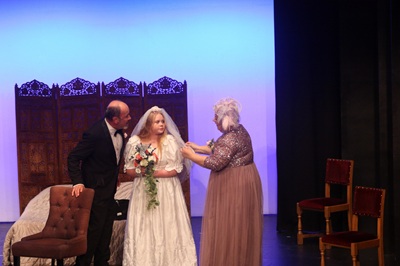
Unlike the first two acts, which feature different couples in Suite 719 of the Plaza Hotel, Act Three focuses solely on Roy and Norma Hubley as they try to coax their daughter from the bathroom on her wedding morning. Presented on its own, the act felt liberating rather than limiting, revealing itself less as farce and more as a finely tuned study of parental panic.
The set convincingly suggested an upmarket hotel room within festival constraints. A screen against the cyclorama cleverly allowed Roy to appear as if edging along a perilous ledge, while the unseen bathroom door became an antagonist in its own right — each knock carrying symbolic weight.
Georgie Lucas avoided caricature as Norma, offering restraint and emotional depth, particularly in a quiet moment of near-collapse that grounded the scene. Her American accent was natural, well matched by Malcolm Buckoke’s assured performance as Roy. Malcolm charted Roy’s journey from brittle joviality to exposed vulnerability with impressive control, uncovering surprising pathos within Neil Simon’s comic dialogue. The chemistry between the leads sustained the piece. With no structural variety to rely on, the success depended on marital rhythm, and here it rang true. By the time the bathroom door finally opened, the audience was ready for either collapse or catharsis. The production wisely chose restraint, suggesting that simple survival was triumph enough. As a standalone piece, it proved that sometimes one suite is all you need for a full evening’s stay.
Both actors were nominated for best Actor/Actress
Tuesday 24th February
“Heavy Weather” by Lizzie Nunnery performed by Glow Theatre Group
This production was staged with an all-female cast of 15–17-year-olds. The large ensemble has a key role in the development of the play, with well-choreographed and disciplined movement, positioning and gesturing, involving visually striking use of illuminated mobile phones.
School refuser Mona, portrayed with intensity and passion by Connie McMillan, is desperately concerned about the state of the world plagued by climate change and pollution. She also wants to re-connect with her mother, who abandoned her at an earlier age when she found motherhood too taxing. Rosie Butler is Mona’s older sister, Elin, who first tries to curb Mona and make her return to school but later shows a softer, caring side.
As Mona sets out to change the world, she encounters an influencer, strikingly portrayed as shallow and pretentious by Stella Pellegrini Perez. Mona finds her way to a well-staged and colourful gathering of climate change protesters. Skye Wilkinson is a guru dispensing empty ‘mindfulness’ solutions to the climate crisis, who turns on Mona when she does not toe the line. Further disillusion follows with the appearance of two ‘welfare’ workers, Gabby and Angela, supposedly to help Mona. Their transition from caring to controlling and ultimately coercive was very convincingly portrayed by Bella Marro and Maisie Felstead. Final disappointment comes when Mona meets her mother. Florence Swift’s Lucinda is also a climate change protester, but there is no reconciliation as Mona sees her mother as weak and unreliable. Mona decides to continue to seek solutions to the planet’s problems and the play concludes with her musical plea to ‘hear me’.
Mark Wakeford Award for Best Stage Presentation
Best Youth Production“Blood on Canvas” by Richard James performed by Merstham Amateur Dramatic Society
This two-hander is set in an artist’s studio/gallery in an isolated location in an unnamed remote area, away from the distractions of other places, according to the artist Maddie. Upstage is a line of easels displaying the artist’s work. There in an empty easel stage left with a pedestal with a wine bottle and glasses slightly inconveniently in front of it. A trunk sits stage right and provides the only seating.
Imelda Smith’s Stella arrives at the studio flustered and upset by its remoteness, complaining about her unreliable satnav which she likens to her ex-husband. She purports to be an art collector with an interest in acquiring one of Maddie’s works. Garrulous and somewhat irritating, it soon emerges that Stella knows nothing about art. In contrast, Katie Alvarez gives Maddie a much calmer and more measured persona, indulging Stella’s rather vacuous rambling.
The play is a slow burn. Stella is concerned about her car being stolen. Tension begins to build once mention is made of a killer at large in in the area. Conversation turns to speculation about how Stella might carry out a theft of a painting and how each woman might perpetrate a murder. Suspicion grows that one of the two women could be the killer. It emerges that Stella is not the person she presented herself to be in several respects. Maddie’s cool demeanour becomes more controlling and menacing. The climax arrives with a violent murder and the revelation that there is already another body in the trunk.Wednesday 25th February
“A Monster Calls” by Patrick Ness, inspired by an original idea by Siobhan Dowd, devised by Sally Cookson, Adam Peck and the Company performed by Glow Theatre Group
Over the past three years, I have observed this Glow Theatre Group grow into a disciplined and assured ensemble, and this production of A Monster Calls confirms just how far they have come. The abridged adaptation captures the emotional core of the novel with clarity and restraint, transforming it into a visually striking and deeply affecting piece of theatre.
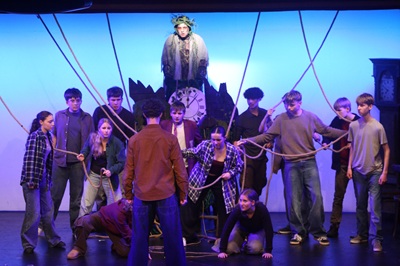
The story followed Conor, a boy struggling to cope with his mother’s terminal illness. The streamlined structure tightened the narrative, focusing sharply on Conor’s inner conflict and the unsettling stories told by the Monster. By trimming subplots and secondary characters, the production achieved an intimacy that drew the audience directly into Conor’s turmoil. Eschewing elaborate spectacle, the company relied instead on stylised movement and minimal props. The director, Jo Morrison, with the help of Kim McEvoy also employed an impressive use of ropes and chairs, while the totemic structure at the rear of the stage provided a powerful focal point for the Monster’s emergence. The creature’s costume, physicality and resonant voice created a presence both protective and menacing, an embodiment of Conor’s conflicting emotions.
The sound effects and music, operated by Dom Palmer, enhanced the atmosphere throughout, however, if there was a flaw, it lay in the slightly rushed journey towards the climax. A little more silence at key moments might have allowed the emotional weight to land more fully. Will Shackelton delivered a sincere and emotionally grounded Conor, deservedly going on to win the Best Young Actor award, while Sam Church’s commanding Monster balanced power with nuance. Matilda Herd (Mum) and Hector Hall (Harry) gave thoughtful, measured performances. Together, Will, Sam, Matilda, Romily, Hector, Drew, Tobias, Mallik, Emily S, Bella, Oliver, Nathaniel, Aggie, Emily H and Jake honoured the spirit of the story while embracing the unique strengths of live theatre.
Best Young Actor – Will Shackleton
“Rock, Paper, Scissors” by Caroline Tajasque performed by Runnymede Drama Group
Rock, Paper, Scissors by Caroline Tajasque is a compact theatrical piece that probes the tension between family ties, hidden histories and the choices that define us. The audience was treated to a masterclass in fresh, emotionally direct writing.
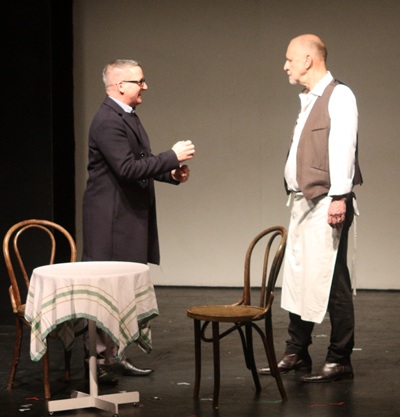
Peter Gatzmeier arrives at a café in the former East Germany to confront his past. Nick Lund captured Peter’s nervous anticipation — anxiety tempered by hope — with admirable precision. After his mother’s death, Peter discovered a photograph of her with Martin Gatzmeier at the Café Lotto and, believing him to be his father, set out in search of answers. When Martin appeared, their confrontation was immediate and compelling. Mike Ainsworth’s gruff authority suggested a guarded, emotionally repressed man shaped by circumstance, yet he never slipped into caricature.
Martin’s account of the past was framed through the deceptively simple imagery of the titular game — rock, paper, scissors — a metaphor for risk, power and the arbitrary turns that shape our lives. The revelations were delivered with clarity and restraint: Martin is not Peter’s father but his uncle, and Peter’s father died in a tragically misguided attempt to reach the West, after which Peter’s mother relocated to England with her infant son. These disclosures were handled without unnecessary embellishment, allowing the tension to tighten organically rather than rely on melodrama. Peter’s anguished cry — “Why didn’t she love me?” — landed with genuine dramatic force.
The play captured a moment in which past and present collided, inviting the audience to consider how much of life is shaped by deliberate choice and how much by chance. Both actors delivered powerful, finely controlled performances, with Nick Lund deservedly going on to win the Best Actor award. Under the attentive direction of Paul Foster, the production demonstrated how thoughtful staging and disciplined acting can convey remarkable emotional complexity within a short form. It was a measured, intelligent and quietly powerful piece of theatre that lingered long beyond its final line.
Best Adult Actor – Nick Lund
Thursday 26th February
“A Human Write” by Amelia Armande performed by Glow Theatre Group
Another production with a large ensemble cast of energetic and animated young players. The ‘chorus’ begin with dance and mime on the theme of writing – pages read and discarded, typewriting. There is fragmentary speech – news, adverts, TV jingles. Stories are begun - “Once upon a time ...” but falter and fade
A writer emerges but he’s suffering from writer’s block. Harvey Auer effectively portrays the writer’s frustration and engages in spirited interaction with the chorus who chastise and urge him to produce a story. He cannot stop the voices harrying him and thinks about giving up. The chorus begins a story about a girl on a bus that the writer sees every day and wants to get to know. Vienne Punjani gave the girl Janis a warm, friendly disposition, inducing in the writer a long declaration of his love and wish, ultimately, to marry her. No relationship develops however – an indication of the frequent lack of happy endings in stories. The writer protests at the continued badgering from the chorus but then realises they are voices in his own head – he’s talking to himself.
Action goes back to school days and the writer’s early efforts at story-writing. Merry Thackray is a teacher cruelly mocking and dismissive of his attempt at a story and aspiration to write. He perseveres nonetheless and succeeds in quietening the chorus as he begins to compose a new story.
Adjudicator’s Award for opening choreography“Erica and Me” by Alan Robinson performed by Betchworth Operatic and Dramatic Society
Mistaken identities are a classic ingredient of successful farce. Simon has difficulties with women but wants to impress his boss and hires an escort to pose as his girlfriend. The boss and wife are coming to dinner. A woman arrives who Simon takes to be Erica, the escort. Kieran O’Neill’s Simon was a mess of nervous awkwardness from the first encounter with Erica, who has little English and no understanding of the escort role. With few lines but vivid expression, Emöke Sopronie convincingly conveyed Erica’s total incomprehension about the situation with Simon.
Mr and Mrs Collings arrive. Gerald and Tracey Hulf showed excellent stage presence and comedic interaction in these roles. The Collings are confused by Erica and become even more so when a second Erica appears. Dee Coutts is a chatty, dizzy blonde who mistakes Mr Collings for her client Simon, leading to a conversation at serious cross purposes. Mrs Collings is alarmed at Simon’s loose living arrangements with two women. The two Ericas get into a fight. They are in the kitchen cooling off when another Erica arrives, due to a mix up at the agency. Jane Seymour’s Erica 3 is a bold and imposing presence, who reveals she had a previous escort assignment with Mr Collings. Mrs Collings is seriously displeased and leaves, talking of divorce. Erica 2 and 3 depart to set up their own escort agency. Linda Slater is a fourth woman who arrives looking for Erica 1 who is on an exchange and is meant to be looking for a flat. With Erica 1 gone, Simon invites his new visitor to stay for dinner. Her name is Erica.“Artemis Unmasked” by Jill McMilan performed by Leaderbeing
Apart from a brief introduction by a second female actor, this is a solo performance by a woman who, during an extensive monologue, identifies herself as, or with, Artemis, the goddess of hunting, the wilderness, nature, care of children and childbirth. Jill McMillan carried this off impressively, with masterful command of the audience’s attention and well-modulated variations of pace and pitch over a very stretching soliloquy. She was well-supported in this by a slow version of Blondie’s Heart of Glass as a musical underscore and transition piece.
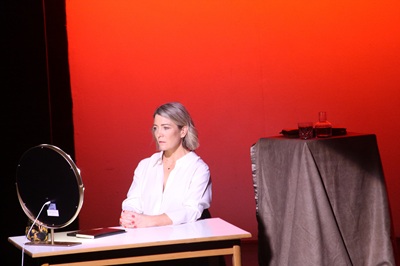
The woman, a successful professional business-person, initially moves from a dressing table to a lectern where she is preparing to give a presentation. She reflects on the need to convince her audience she is a leader. It’s a matter of showing ‘competence not cleavage’. It’s a challenge for female CEOs in general. They must be bold but not intimidating. The performance becomes the person.
She moves to a boardroom table and talks about how to handle a meeting, including dealing with a ‘flyweight’ male. She catches sight of another version of herself - her real self which she lost or left behind on the way to the top. Now she is feeling breakable, with her self-control concealing the cracks. She sees her real self in Artemis - hunter, guardian and a means to ‘make safe harbour’. As Artemis she has a backbone and can be shaping rather than being shaped. The woman speaks directly to the audience, encouraging all to recognise “We are Artemis” – providing a homecoming to our true selves.
Jill Perry Award for Best Adult Actress – Jill McMillan
Martin Patrick Award for Best Director – Jill McMillan
Best Adult Production
VERLINGUE FESTIVAL WINNERS
Friday 27th February
“Small Fry” by Neil Duffield performed by Glow Theatre Group
This was a big cast (36) ensemble production delivered with high energy, strong animation and well-choreographed movement throughout. Speech and facial expressions were clear and effective in conveying the motivation and desires of the different groups.
The play is an allegorical piece set in a disturbing place and time where the prevailing rules are take whatever you want, lie, trust no-one. Money is the only thing that counts. Men are animals and animals are men. There are four different groups in the place. Predators are tough, aggressive and avaricious. Scavengers are streetwise and opportunistic. The Dragon is a malevolent force, representing the worst excesses of unbridled greed – nothing is enough to satisfy its wants. Small Fry are the opposite of the other groups – softer in nature and outlook.
Much of the action revolves around the Scavengers and Predators finding and fighting over a ‘jackpot’ - a box which they believe contains money or valuables. Small Fry are rejected by the other groups as being foolish and naïve, and told to depart. After the Dragon displaces the Predators, the Scavengers get the jackpot back but cannot open it. The Small Fry confound the Dragon on the matter of counting, and it fades away.
The jackpot proves to be empty, and the Scavengers decide they would like the Small Fry to stay around. The Small Fry take the opportunity to re-write the rules – no snatching or grabbing, no lying, trust.“Toad’s Trial” by Kenneth Grahame (adapted by Christine McNeice) performed by Essendene Lodge School
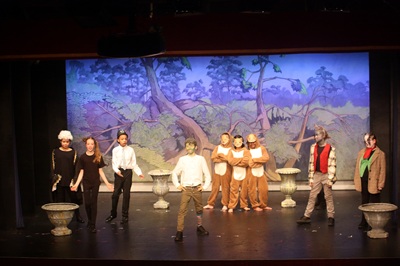
This much-loved children’s classic was given a lively and energetic interpretation by the young drama group from Essendene Lodge. It opens in court where Eleanor Anderson is a forceful judge with a fierce stare. Two stern and commanding policewomen are on hand – Olivia Kpobie and Efe Azenabor – who have arrested Toad for reckless driving. Ralph Hughes’ Toad is a charming rascal, guilty only of his own ‘magnificence’. He had ‘borrowed’ a car, not stolen it, and was ‘testing the brakes’ when he crashed it.
Alice Carnt, Ahaana Panicker and Freya Milles were a strong team of Toad’s concerned friends – Ratty, Mole and Badger – who tried but failed to keep Toad on the right path. Ariana Lovegrove-Whitley was an expressive narrator who loudly and clearly helped drive things along.
Toad is consigned to jail where other actors in black form a line of bars to his cell. He bridles under the watchful eye of an unsympathetic jailer, Isobel Doody. Good fortune appears in the shape of a buoyant, perky washer woman, Safa Ali, who takes pity on Toad and helps him escape, instructing him on a little song and dance on the way.
Toad meets up with his riverbank friends to discover weasels have taken over Toad Hall. Badger hatches a plan to recapture Toad Hall. The four friends use an underground passage to surprise some well-costumed weasels who are easily cornered, before equally easily escaping. Toad vows to change his ways, but falters when he hears a new motor car. Poop, poop!
“Three Characters in Search of a Verdict” by Sue Gordon performed by Glow Theatre Group
This trio of fairy tale court cases opened with a striking silhouetted tableau of the cast. The judge, Lewis Felstead, made an impressive entrance in an oversized wig and the usher, Sofia Lord, was a prominent and highly audible presence throughout the three cases. Oaths were sworn on a book of fairy tales.
In the first case, Jack, of beanstalk fame, ( Betsy Whitehead) showed a cheeky demeanour when facing a smug prosecution lawyer, Lara Taylor. The highlight of this case was the testimony of the impressively tall giant’s wife (Freya McAlister) who cried seemingly bitter tears over the loss of her husband. However, under pressure from a smooth defence lawyer, Kyle Mann, she crumbled and admitted hers was not a happy marriage.
The Goldilocks trial featured a sharp prosecutor in Megan Brodie, a somewhat hesitant but effective defence lawyer (Ilana Nagamootoo) and a very disputatious family of bears – Nikolai Bikhazi, Florence Abbott and Lucy Mellington. Baby bear was distraught when he learnt his favourite chair had actually been wrecked by his cool dude dad when drunk. Sweet and innocent Goldilocks, Bryony Frost, had been on her paper round when visiting the bears’ house.
The prosecutor in the Red Riding Hood case was a colourfully dressed, commanding character (Tristan Lether), while the defence was a well-disciplined team of three – Kyle Mann, Betsy Whitehead and Merry Connell. Lily Ayres’ Granny was deaf, doddering and a useless witness. Rafferty Loughlin’s big bad wolf was rather nerdish but spirited in his defence, complaining about discrimination against wolves and claiming he was a ladies’ nightwear salesperson. Another goes in a fairy story.Saturday 28th February
“The Snow Dragons” by Lizzie Nunnery performed by Glow Theatre Group
The curtain rose on a forest of cast members carrying leaf-covered umbrellas as trees, immediately creating a striking visual image. Alongside the evocative music, this set the tone for a compelling piece of drama. Four of the “trees” became a chorus, observing the action and interspersing it with haunting live music written by Lana Carter and beautifully performed by Lana, Olivia Houghton, Juliana Gadd and Tom Brooker.
The set, a playground of scaffolding, fir trees and snow-covered rocks scattered with weapons, offered dynamic possibilities. The actors clambered and raced across it with confidence and energy. Fearless Raggi (Brooke Patterson) and her gang brought their Snow Dragon sagas to life with sharp comic timing — whether squabbling, boasting of heroic exploits, or lamenting their hunger, each character felt distinct and authentic.
The mood shifted dramatically as the children watched from the trees while their village was raided. What began as playful sabotage from afar became a sobering confrontation with war and survival. The production skilfully balanced imagination and reality: these may be ordinary children, but through their stories — and through Snorri’s heroic tales — they become heroes both in fantasy and, perhaps, in truth. The ensemble work was outstanding. Brooke, Sophie, Isabelle, Emmylou, Linus, Imogen, Charlie and Amelie created a cohesive, vibrant company under Jackie Driscoll’s assured direction, underscored effectively by Dom Palmer’s music. The final tableau, underscored by the chilling sound of machine guns, was deeply moving and left a lasting impression.
Best Young Actress – Brooke Patterson“A Thing of Beauty” by Charles Kray performed by Oast Theatre
This compelling one-act play, based on real events, centres on a Nazi officer pursuing Edith Stein, the Jewish philosopher who converted to Catholicism and entered a convent.
The staging is simple yet effective: an altar bearing a symbolic cross and candles, a desk and two chairs for the prioress, and three chairs suggesting a church pew. Lighting, costumes, and the opening plainchant establish the atmosphere of this well-constructed and powerful narrative. All three performances were strong and finely judged.
Annie Young’s prioress evolves from a well-meaning, maternal figure to a woman anguished by the prospect of sacrificing one life to save many. It is a dignified and deeply moving portrayal, full of quiet pathos.
David Adams delivered a wholly believable Colonel. Initially presented as a bullish Nazi officer, he gradually revealed layers of inner turmoil and self-doubt. As he wrestled with his conscience, he unexpectedly drew the audience’s sympathy. It is a demanding role—he is on stage throughout—but Adams sustained the character with impressive control and nuance. Karen Garbutt’s Sister Benedicta possessed real stage presence. Her poise and assurance were both striking and affecting, and her line, “It is my life,” landed with powerful dramatic force. The play raised searching questions: what is the relationship between her moral resolve and her faith? She provides a compelling counterbalance to the Colonel, and their philosophical exchanges are charged with intellectual and emotional intensity. The moral dilemma at the heart of the play: if she confesses her ancestry, might he release nineteen other nuns bound for a death camp? And if she refuses, could she instead awaken something in him. The moral dilemma created compelling dramatic tension. By its nature, the play is largely static, yet the director wisely kept movement minimal, allowing the language and performances to drive the action. The result was a seamless and absorbing production that lingered in the mind.
The adjudicator’s nomination of Karen Garbutt (Benedicta) for Best Adult Actress was richly deserved.
Reviews by Morven Rae & Peter Damesick
Photos by Mike Sutton